Since the roll-out of Phase Two e-invoicing effective January 1, 2023, the initiative’s primary goal has been to integrate all sales transactions within a centralized platform, converting paper-based invoices and credit/debit notes into a standardized electronic process between buyers and sellers. This system allows for the efficient exchange and processing of invoices/notes in a structured electronic format, enabling more precise tracking of economic activity.
This guide delves into Phase Two e-invoicing, with a focus on supporting SMEs in selecting the right accounting software, organizing their accounting workflows, and preparing for Phase Two compliance requirements, along with other key considerations. Whether you’re a business owner or an accounting professional, this document provides you with in-depth guidance and answers to frequently asked questions.
What is Phase Two E-Invoicing?
Phase Two, also known as the Integration Phase, expands upon Phase One of e-invoicing. In this phase, a taxpayer’s e-invoicing solution is linked to ZATCA’s Fatoora Portal. Starting January 1, 2024, Phase Two applies to taxpayers with an annual VAT-taxable turnover exceeding SAR 70 million for 2021 or 2022.
When will Phase Two E-Invoicing Apply to SMEs?
Phase Two e-invoicing has been rolled out in waves, beginning with large businesses on January 1, 2023. As of January 1, 2024, this phase will extend to SMEs with a turnover above SAR 70 million in 2021 or 2022. The rollout will continue progressively until ZATCA achieves its goal of integrating all businesses across all sectors into the e-invoicing system.
E-Invoicing Requirements for SMEs
To issue e-invoices, businesses must fully observe ZATCA’s regulations and guidelines, share invoices within specified timeframes, and maintain compliance with tax authorities, including the use of electronic signatures. This ensures a smooth transition to digital document exchange.
The key requirements are summed up as follows:
- Ensure your e-invoicing solution is integrated with ZATCA’s Fatoora Portal.
- Use the approved formats (XML or PDF/A-3 with embedded XML).
- Confirm that the e-invoicing solution is internet-connected.
- Include all Phase Two required additional fields in the e-invoice.
Direct Integration with ZATCA Platform
In Phase Two e-invoicing, direct integration with ZATCA’s platform becomes mandatory. Businesses must generate invoices in XML or PDF/A-3 format and submit them to ZATCA within 24 hours of issuance. This integration allows ZATCA to review, validate, and clear invoices, thereby enhancing transparency and ensuring tax compliance.
Digital Signature Requirements
The digital signature is a crucial component in Phase Two to guarantee the integrity and authenticity of submitted invoices. It is used to verify the accuracy of the information within the invoice and to prevent tampering after issuance. The digital signature system employs complex algorithms and encryption techniques to safeguard invoices against forgery.
Penalties for Non-Compliant Businesses
Businesses that fail to comply with the Phase Two implementation requirements will face financial penalties and sanctions, as was the case in Phase One. ZATCA has pointed out that the penalties associated with e-invoicing include:
- A fine of SAR 5,000 for failing to issue invoices electronically.
- A fine of SAR 5,000 for failing to store invoices electronically.
- A warning, followed by a financial penalty, for issuing simplified tax invoices without QR Codes.
- A warning, followed by a financial penalty, for failing to report to ZATCA any malfunction preventing the proper generation of e-invoices.
- A fine of SAR 10,000 for deleting or altering an e-invoice.
It is important to note that violators of the E-Invoicing Regulations are subject to the provisions of the Value Added Tax (VAT) Law and its implementing regulations. According to Article 45 of the VAT Law, a violator of any provision of the law or its regulations may be fined up to SAR 50,000.
Specifications for E-Invoices (XML and PDF/A-3)
Phase Two e-invoices must be generated in either of the two approved formats: XML or PDF/A-3. These formats offer a robust invoice handling structure that presents the required data in an organized and easily verifiable manner. They also ensure compatibility with various reading systems, enabling smooth data processing.
Legal Compliance
Phase Two mandates strict adherence to the legal compliance guidelines set by ZATCA. Businesses must ensure their e-invoicing solutions are compliant with applicable regulations, including the use of digital signatures, invoice storage in specified formats, and timely submission to ZATCA. Following these guidelines helps businesses avoid penalties and maintain legal compliance.
Qoyod Features
Qoyod provides a complete solution for Phase Two e-invoicing requirements. With seamless integration with ZATCA’s systems, Qoyod facilitates invoice generation in the approved formats, applies digital signatures, and offers businesses both flexibility and security in financial transactions. Additionally, Qoyod provides accurate financial reporting and robust invoice management, driving operational efficiency and minimizing errors.
What Does a Phase Two Tax Invoice Include?
Simplified Tax Invoice Contents:
- Invoice title (Simplified Tax Invoice).
- Invoice date and time.
- Serial number.
- Seller information.
- Buyer information.
- QR Code.
- Store address.
- VAT registration number.
- VAT-inclusive amount for each item.
- Total invoice amount (VAT-inclusive).
Standard Tax Invoice Contents:
- Invoice title (Tax Invoice).
- Invoice date and time.
- Serial number.
- Seller information.
- Buyer information.
- QR Code.
- Vendor’s commercial registration number (or other identifier).
- Total invoice amount (VAT-exclusive).
- Total invoice amount (VAT-inclusive).
Note:
In Phase Two e-invoicing, the reason for issuing a credit note must be included (for returns on both standard and simplified e-invoices).
| Tax Invoice Sample
(Typically B2B) Always ensure all mandatory fields are included to avoid e-invoicing (Fatoora) violations. · Invoice Title: Tax Invoice — typically used for B2B transactions · Invoice Serial Number · Additional Vendor Identifier (e.g., Commercial Registration Number) · Buyer Information · Total (Excluding VAT) · Seller Information · Total (Including VAT) · QR Code · Invoice Date and Time |
Types of transactions and their required e-invoices/printed invoices
| Transaction | Tax Invoice | Simplified Tax Invoice |
| Standard-rated supplies of SAR 1,000 or more, provided to a taxable person or non-taxable legal person | ✔ | |
| Taxable supplies (other than exports of goods) provided to a taxable person or non-taxable legal person, valued less than SAR 1,000 | ✔ | ✔ |
| Exports of goods | ✔ | |
| Taxable supplies provided to a non-taxable natural person (other than exports of goods) | ✔ | |
| VAT-exempt supplies in Saudi Arabia | N/A | N/A |
| Zero-rated supplies of SAR 1,000 or more, provided to a taxable person or non-taxable legal person | ✔ |
Types of transactions and their required e-invoices/printed invoices
| Transaction | Tax Invoice | Simplified Tax Invoice |
| Standard-rated supplies of SAR 1,000 or more, provided to a taxable person or non-taxable legal person | ✔ | |
| Taxable supplies (other than exports of goods) provided to a taxable person or non-taxable legal person, valued less than SAR 1,000 | ✔ | ✔ |
| Exports of goods | ✔ | |
| Taxable supplies provided to a non-taxable natural person (other than exports of goods) | ✔ | |
| VAT-exempt supplies in Saudi Arabia | N/A | N/A |
| Zero-rated supplies of SAR 1,000 or more, provided to a taxable person or non-taxable legal person | ✔ |
How to Choose the Best E-Invoicing Solution for Your Business
When selecting an e-invoicing solution for your business, it’s essential that the solution meets ZATCA’s integration requirements and, more importantly, offers features that make it easy to use and enhance the overall user experience.
Here are several standout features that can help ensure your e-invoicing solution is the right choice:
Data Security Compliance
A top-tier e-invoicing solution should rigorously comply with data security regulations, ensuring that purchase and payment records are stored for a specified period, vendor and customer information is safeguarded, and secure, compliant e-signature protocols are implemented.
Customizable Invoice Options
An ideal solution should offer extensive customization features, enabling businesses to tailor the size, layout, font, and template of their invoices. This level of flexibility not only sets the solution apart but also guarantees the comfort and convenience that every enterprise values most.
Maintaining Up-to-Date ZATCA Integration
To stay ahead of competitors, your solution should consistently stay aligned with the latest ZATCA integration updates.
Tax Declaration Compliance
Retailers with an annual turnover exceeding SAR 375,000 are mandated to submit tax declarations. Since this can be a daunting task, many merchants rely on integrated accounting software to manage this process for them. Your solution should, therefore, streamline the preparation and submission of tax returns, making it both efficient and straightforward.
Ease of Use and Prompt Technical Support
The more a solution offers clear tutorials, responsive technical support, and ongoing educational resources to guide clients through Phase Two e-invoicing requirements, the more it will stand out among competitors and establish itself as a preferred choice. By saving time and reducing effort, such a solution meets the universal demand for simplicity and ease of use.
Multiple Payment Options
Many solutions fail to offer a wide range of payment options, limiting their appeal to a broader customer base, even if they’re capable of managing, storing, and submitting ZATCA-complaint e-invoices. By incorporating multiple payment options, your solution gains an edge over competitors and can drive consistent sales growth.
Automatic Invoice Submission to ZATCA
A solution that enables automatic invoice submission to ZATCA not only saves merchants valuable time but also accelerates the sales process. This feature sets your solution apart, as certain invoices need to be submitted to ZATCA for review and clearance before being issued to the buyer.
Detailed Sales Reports
To ensure efficient Phase Two implementation, your solution should provide comprehensive, real-time reporting accessible from a single dashboard. This feature simplifies the tracking of invoicing activities related to sales, inventory, suppliers, and more.
Phase Two Roll-out Waves
The implementation of Phase Two e-invoicing commenced in early 2023, initially targeting high-income businesses with an annual turnover of SAR 3 billion or more, and gradually expanded to include smaller businesses. Starting in 2024, compliance will be mandatory for businesses with an annual turnover exceeding SAR 70 million.
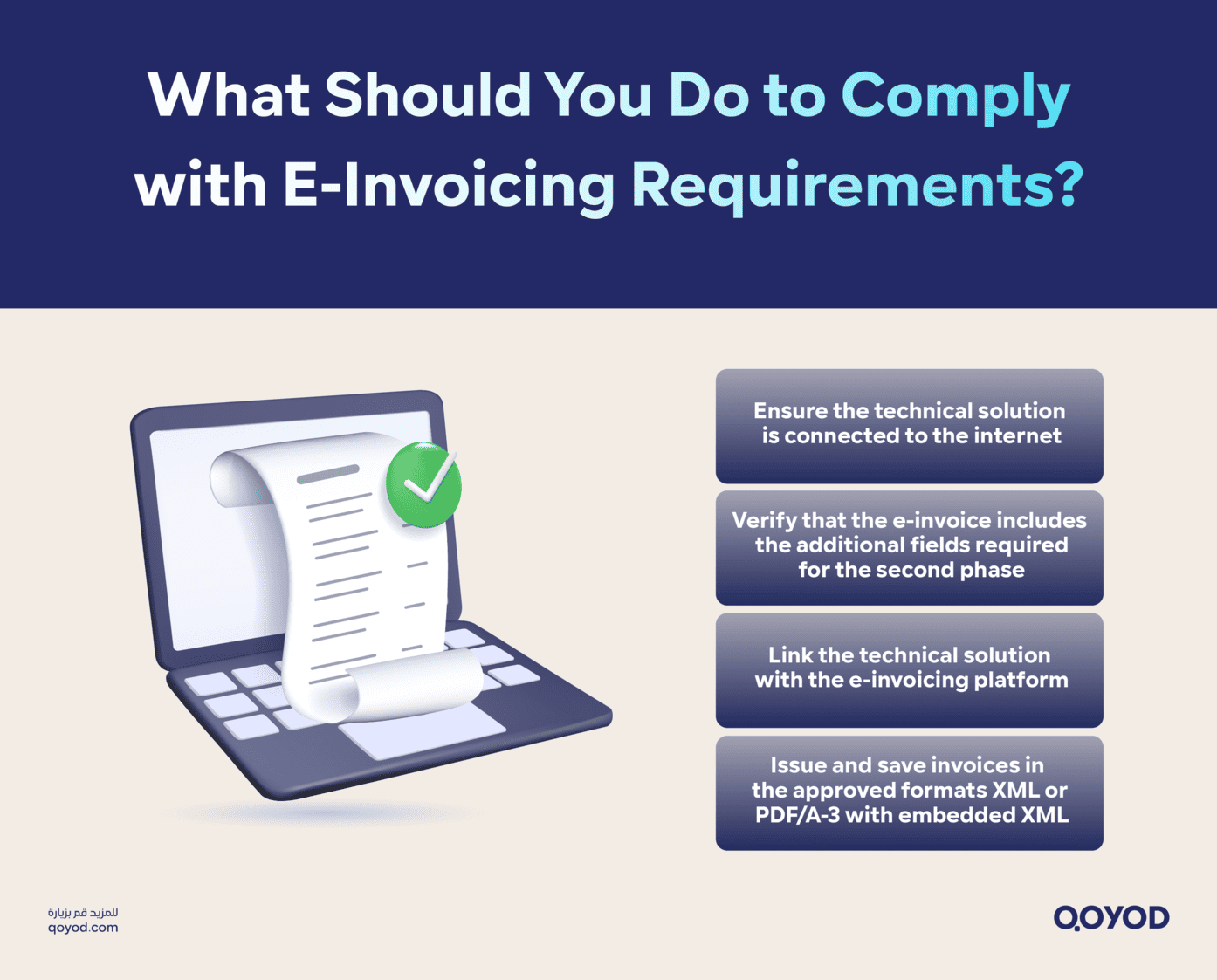
Compliance with E-Invoicing Requirements
To comply with e-invoicing requirements, follow these steps:
- Ensure your solution supports internet connectivity.
- Integrate the solution with the Fatoora Portal.
- Ensure all required additional fields for Phase Two are included.
- Generate and store invoices in the approved formats (XML or PDF/A-3 with embedded XML).
How Phase Two E-Invoicing Works for Simplified Tax Invoices
(Typically B2C)
- The seller generates the e-invoice for the customer, ensuring all required fields for a simplified tax invoice are included.
- The seller provides the e-invoice to the buyer.
- The seller stores the e-invoice in their e-invoicing system.
- The seller shares the e-invoice with ZATCA within a maximum of 24 hours. This process is automated through the seller’s solution integrated with the Fatoora Portal.
Important Note: A critical pitfall to avoid is generating invoices through an e-invoicing solution that has not been properly configured and integrated with ZATCA.
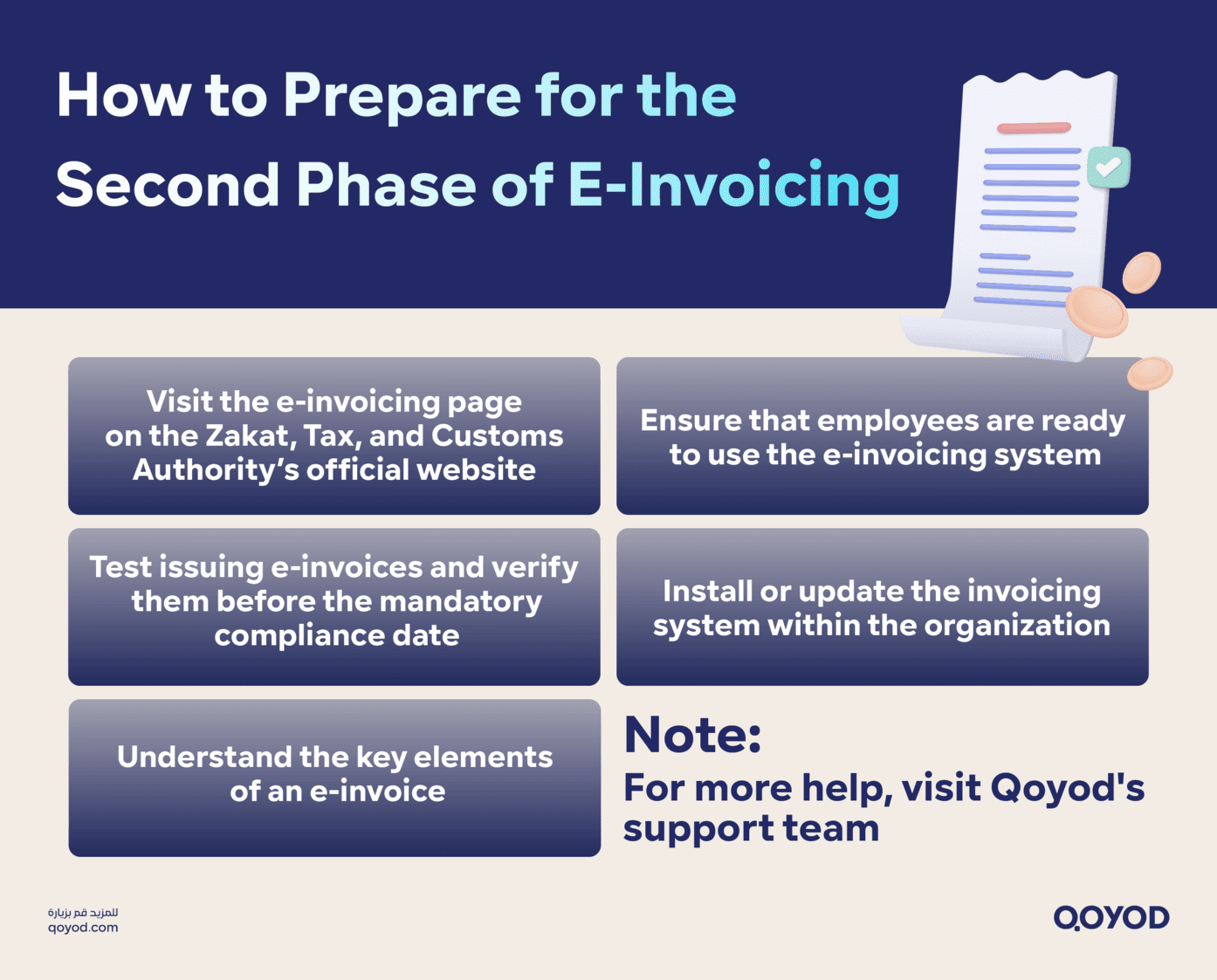
How to Prepare for Phase Two E-Invoicing
- Visit the E-Invoicing page on ZATCA’s official website.
- Install or upgrade your organization’s e-invoicing solution.
- Ensure your staff is ready to use the e-invoicing solution.
- Understand all e-invoice components.
- Test e-invoice generation to verify functionality before the mandatory compliance date.
Your Complete Guide to E-Invoicing (PDF)
Get your comprehensive guide to Phase Two e-invoicing for SMEs!
Are you looking to learn more about complying with the new e-invoicing regulations?
We offer a detailed guide that covers everything you need to know about Phase Two, including the requirements, practical steps, and best practice to make the transition easier.
Download the guide now for free and get fully prepared for Phase Two with confidence!
Download the Guide
Resources You May Find Helpful:
ZATCA’s Simplified Guidelines for E-Invoicing
ZATCA’s Detailed Guidelines for E-Invoicing
ZATCA’s Fatoora Portal User Manual
Tutorial on Phase Two E-Invoicing
All you need to know about Phase Two e-invoicing (The Integration Phase)
Frequently Asked Questions (FAQ) About Phase Two of E-Invoicing
What is Phase Two of e-invoicing in Saudi Arabia?
Phase Two, known as the “Integration Phase,” requires businesses to connect their e-invoicing systems to the ZATCA platform and transmit invoices electronically in real time or near-real time. The rollout is gradual and based on companies’ annual revenue.
Which companies are subject to Phase Two requirements?
All VAT-registered businesses in Saudi Arabia exceeding certain annual revenue thresholds are required to comply. The revenue threshold started at SAR 3 billion and is decreasing each wave, reaching SAR 750,000 by 2026. ZATCA notifies each company at least six months before their designated compliance date.
What are the technical requirements for Phase Two?
Integration with the official FATOORA platform (ZATCA E-invoicing portal).
Issuing invoices in XML or PDF/A-3 (with embedded XML).
Mandatory data fields: digital signature, QR code, and other fields required by ZATCA.
What are the penalties for non-compliance?
Penalties include:
Fines from SAR 1,000 to SAR 50,000, depending on the type and recurrence of violations.
Official warnings, escalating to higher fines.
Potential suspension of business operations and reputational impact.
A grace period is usually provided before fines are increased.
How do I choose the best e-invoicing software for Phase Two compliance?
Ensure that the solution:
Is fully compliant with ZATCA requirements.
Offers robust local support and customer service.
Generates invoices with all necessary elements (digital signature, QR code).
Integrates easily with your ERP system and provides detailed reporting.
6. When should my company start applying Phase Two requirements?
ou will be notified at least six months in advance by ZATCA. Preparation should begin as soon as you receive the notice—review your invoicing system and start the integration process immediately.
What invoice formats are accepted in Phase Two?
Invoices must be in XML or PDF/A-3 format, with the XML file embedded, and should follow the official data structure published by ZATCA.
What’s the difference between Phase One and Phase Two?
Phase One: Requires issuing and storing e-invoices, with no direct integration with ZATCA.
Phase Two: Requires real-time or near-real-time integration, sending invoices directly to ZATCA for verification.
What are the key steps to prepare for compliance?
Upgrade or purchase ZATCA-compliant invoicing software.
Train staff on the new system and requirements.
Test invoice generation and integration before your go-live date.
Where can I find official updates or get support?
Visit the official ZATCA website or consult your licensed e-invoicing solution provider for the latest guidelines and technical documentation.
10. How can I prepare my business for Phase Two?
- Update your e-invoicing system to ensure compatibility.
- Train your staff on the new processes.
- Conduct testing to confirm your system’s readiness for integration.
- Maintain an active internet connection for invoice sharing.
11. Where can I find more information about Phase Two?
For further details, visit the official ZATCA website or consult with approved e-invoicing solution providers.